
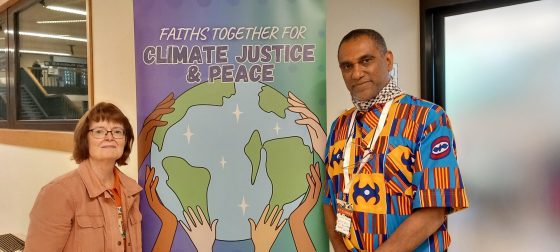
People of faith around the world are being invited to join a global mobilisation for climate justice in April 2027, bringing spiritual conviction, community action and public pressure together to help secure a just transition away from fossil fuels.
What can faith communities contribute to the struggle for climate justice? The answer, according to speakers at the global kickoff of Faiths Rising on 28th October, is far more than prayers and words of encouragement. Faith communities can help change hearts and minds, strengthen frontline communities, mobilise public opinion and press governments to take the action that the climate crisis demands.
Faiths Rising is a global, multifaith mobilisation coordinated by GreenFaith and the Faiths for a Fossil Free Future coalition. Its central purpose is to build support for a rapid and equitable phase-out of coal, oil and gas, a swift expansion of renewable energy and a binding international agreement to make the transition possible.
The campaign will culminate in a global week of action from 4–11 April 2027, when churches, mosques, synagogues, temples and other faith communities are invited to organise activities appropriate to their own traditions and local circumstances. The aim is to demonstrate the strength of public support for a fossil-free future ahead of the next international conference on transitioning away from fossil fuels, to be held in the Pacific in July 2027 and co-hosted by Ireland and Tuvalu, with a preparatory meeting planned in Ireland.
Why faith communities matter
Kumi Naidoo, a leading climate justice activist and Chair of the Fossil Fuel Non-Proliferation Treaty The Fossil Fuel Non-Proliferation Treaty is a proposed international treaty aimed at phasing out fossil fuel production to mitigate climate change. The initiative calls for a global agreement similar to treaties on nuclear weapons, with three main goals: ending the expansion of fossil fuel production, facilitating a fair transition away from existing fossil fuel use, and ensuring support for workers and communities impacted by the transition. The idea is to prevent further environmental harm by stopping new fossil fuel projects and transitioning towards clean energy sources in an equitable and just manner.
• Read about the Fossil Fuel Non-Proliferation Treaty Initiative »
More Initiative, challenged participants to recognise the historic contribution of faith communities to struggles for justice. From the anti-apartheid movement to the civil rights movement and campaigns against nuclear weapons, religious communities have helped provide both the moral leadership and the grassroots networks needed to bring about change.
Their reach is particularly important in poor and remote communities, where places of worship may be among the few enduring sources of community support and organisation.
Naidoo offered a memorable image to explain why the campaign must address the roots of the problem: “We cannot mop the floor when the tap is still running.” Caring for people affected by climate disasters is essential, but it must go hand in hand with confronting the systems that continue to drive the crisis. That means challenging the extraction and burning of fossil fuels, as well as the economic and political interests that sustain them.
Faith communities are well placed to do this because their traditions offer powerful resources for questioning greed, excessive consumption and the abuse of power. They can help people see climate change not simply as a scientific or technical issue, but as a question of justice, responsibility and the kind of world we want to leave to future generations.
Naidoo also stressed the importance of communicating in ways that reach people beyond policy debates and technical language. To move people to action, he argued, “we need to take care of mind, heart, body and soul.” Music, art, storytelling, prayer and shared celebration can all help communicate the urgency of the climate crisis while offering a positive vision of the future.
During the call, he demonstrated this himself by singing We Shall Be Known, a song celebrating the power of community and collective change. It was a reminder that movements grow not only through arguments and statistics, but through relationships, culture and hope.
Making the human cost visible
The urgency of the campaign was brought home by a traditional and spiritual leader from a coastal community in Nigeria. He described how rising seas, ocean surges and the impacts associated with fossil fuel extraction threaten livelihoods, health and the future of his people. Speaking on behalf of a wider group of vulnerable communities, he emphasised the injustice of communities that contribute relatively little to global emissions nevertheless bearing such severe consequences.
Other speakers highlighted the disproportionate burdens experienced by women and marginalised communities, including displacement, pollution, health risks and the loss of livelihoods. These testimonies underline why the transition away from fossil fuels must also be a just transition: one that protects workers, supports affected communities, addresses inequalities and ensures that the benefits of clean energy are shared fairly.
Dr Shannon Shah, speaking about the relationship between energy, faith and justice, argued that the extraction of fossil fuels is not simply a matter of supplying energy. It is also a question of power, wealth and the distribution of environmental and social costs. He urged faith communities to draw on the ethical teachings of their traditions to challenge systems that benefit a powerful minority while leaving others to bear the consequences.
From global vision to local action
Rev. Fletcher Harper, Executive Director of GreenFaith, issued a direct invitation to faith communities to take part. Referring to the scale of participation needed to meet the climate challenge, he said:
“The world is waiting desperately to hear a word of commitment and hope and courage from religious communities.”
Faiths Rising is designed to turn that commitment into visible action. During the week of 4–11 April 2027, communities might organise sermons, prayers, vigils, public demonstrations, meetings with elected representatives, letter-writing campaigns, cultural events or digital campaigns. They may focus on a concern already affecting their locality, linking their own efforts to a worldwide movement.
The campaign is calling on governments to end new fossil fuel development, phase out existing production fairly, with wealthier countries taking the lead, and deliver a rapid transition to renewable energy that prioritises workers and communities affected by the change. Ultimately, it seeks a binding international agreement to provide the cooperation, resources and accountability needed to make that transition happen.
This is particularly relevant to Ireland. Following the first international Conference on Transitioning Away from Fossil Fuels in Santa Marta, Colombia, in April 2026, Ireland and Tuvalu are preparing to co-host the next conference in 2027. The conference process offers an important opportunity to move from recognising the need for change to agreeing how countries can deliver it. Public pressure will be essential if governments are to take sufficiently ambitious decisions.
For Join the Dots Together, Faiths Rising offers a practical opportunity to connect our work for climate justice with a growing international movement. It also reinforces a central conviction of our network: faith is not merely a private source of comfort. It can inspire people to challenge injustice, build solidarity across communities and take collective responsibility for our common home.
The invitation is to begin planning now. Faith communities do not need to have every detail decided before registering their intention to participate. They can start by bringing people together, identifying an issue they care about and considering what kind of action would be meaningful in their own context.
As Naidoo reminded participants, hope must be active. And as Fletcher Harper stressed, this is a moment for commitment, not simply concern.
Faiths Rising invites us to make that commitment visible, together.
Find out more and register an action: Faiths Rising – Faiths for a Fossil Free Future
Further information on the international conference: Second Conference on Transitioning Away from Fossil Fuels