
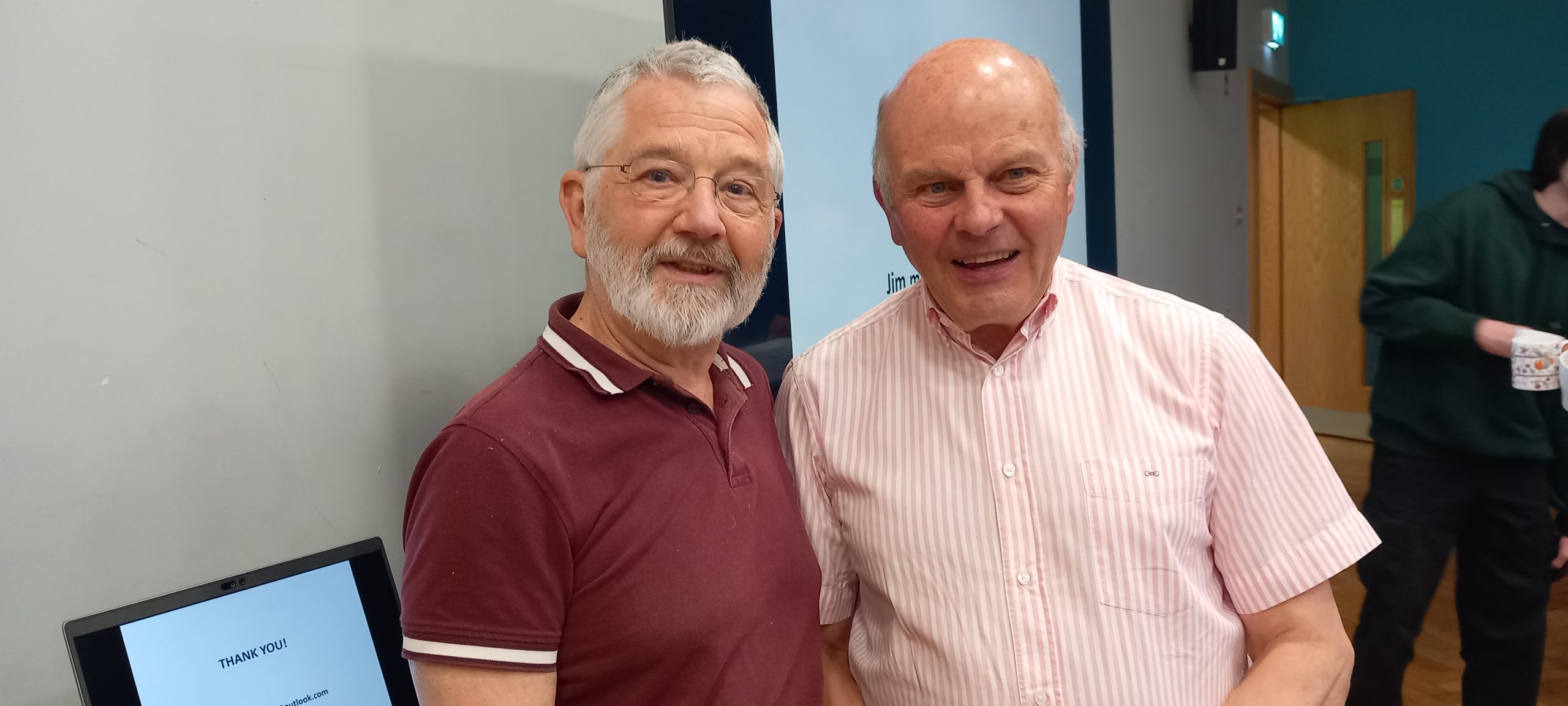
People from different Churches and communities gathered in Newtownbreda Presbyterian Church on 28th May for an important and timely evening focused on the environmental crisis affecting Lough Neagh and the wider ecological future of Northern Ireland.
The event, hosted with generous hospitality by Newtownbreda Presbyterian Church, featured a presentation by environmental scientist Jim McAdam, whose deeply informed and carefully evidenced analysis invited those present to reflect not only on the ecological state of the lough, but also on the responsibility of people of faith to respond with integrity and action.
The evening was a follow-on from the “Let Justice Flow Like Rivers” gathering held in Newry in January, where Church leaders from across traditions began a shared conversation about care for creation and environmental justice. Since then, attention has increasingly turned towards Lough Neagh — its ecological deterioration, its cultural importance and the urgent need for practical cooperation. Church leaders indicated that this work will continue during the Season of Creation The Season of Creation is an annual Christian observance that takes place from September 1st to October 4th. It is a time when Christians around the world come together to pray, reflect, and take action on caring for the environment and addressing ecological concerns. The observance begins on the World Day of Prayer for the Care of Creation (September 1st) and concludes on the feast day of St. Francis of Assisi (October 4), the patron saint of ecology in the Catholic tradition. The Season encourages prayer, education, and advocacy for environmental stewardship. Read more about the Season of Creation » More later this year.
Jim McAdam brought decades of experience to the discussion. Originally from the Ards Peninsula, he worked in forestry and environmental management for many years, including periods connected with the Falkland Islands before retiring in 2018. His presentation ranged widely across agriculture, peatlands, water systems, climate science and land management, yet remained grounded in careful observation and measurable evidence.
One of the strongest impressions of the evening was the objectivity of his approach. Rather than offering ideological arguments or simplistic blame, McAdam repeatedly emphasised the importance of scientific measurement and accurate data. “Measure before you manage,” he said — a phrase that became something of a refrain throughout the evening. Good environmental stewardship, he argued, depends on understanding systems truthfully before attempting solutions.
Speaking about Lough Neagh itself, McAdam explained how the lake has been under pressure for decades, with pollution issues noted as far back as 1964. He described the lough’s unique geography: a shallow body of water with an average depth of only nine metres, fed by thirteen rivers and draining a catchment area of around 5,000 square kilometres. Around 40% of Northern Ireland’s drinking water comes from the lough.
In recent years, however, the ecological balance has become increasingly fragile. Rising water temperatures, excess phosphorus and nitrogen, failing septic systems, agricultural runoff and invasive zebra mussels have all contributed to harmful algal blooms and wider ecosystem disruption. The impacts are now affecting fishing, tourism, public health and local communities.
McAdam stressed that the problems are complex and cannot be reduced to a single cause. He pointed to the long-term effects of industrialised agriculture, changing weather patterns and land use decisions encouraged over decades by government policy. Yet alongside the diagnosis, he also highlighted practical “nature-based solutions.”
Among these were agroforestry, wet woodlands, swales to absorb runoff, restoring peatlands and more sustainable farming methods. Particularly striking was his explanation that agriculture is unique among major sectors because it has the potential not only to reduce emissions but also to store carbon. Healthy peatlands, for example, can lock carbon safely away, whereas damaged or exposed peat releases large quantities of CO₂ into the atmosphere.
Reference was made during the evening to the Climate Change Impact and Carbon Storage Study for Lough Neagh, produced by Jim McAdam for the Lough Neagh Partnership in 2023. The study highlighted the importance of protecting peatlands and retaining carbon within soils and wetlands, warning that degraded peat releases carbon rather than storing it. (Lough Neagh Partnership)
There was also discussion of practical examples already being implemented around the catchment area. One example was the use of swales and nature-based drainage systems developed through projects led by the Ballinderry Rivers Trust. These systems slow and control water flow, helping reduce nutrient runoff into waterways while improving resilience during periods of heavy rainfall and drought. Trials combining swales, check dams and deep-rooted planting schemes have shown encouraging results in reducing pollution entering the Lough Neagh system. (Climate NI)
McAdam described current projects mapping peat depth across Northern Ireland and examining the condition of peatlands near the Lough Neagh catchment. He spoke with encouragement about farms already introducing ecological measures in partnership with Ulster Wildlife, and about growing recognition that environmental restoration must work with nature rather than against it.
The evening also touched on the spiritual and cultural significance of Lough Neagh. Places such as Church Island and the high cross at Ardboe remind us that the lough is not only an environmental resource but part of the shared memory and heritage of the people of Ireland.
Throughout the discussion there was a strong sense that ecological concern cannot remain separate from faith. People of faith are called not simply to hold beliefs privately, but to allow those beliefs to shape economic choices, political priorities and patterns of daily living. Care for creation is not an optional extra but part of living truthfully and responsibly in relationship with God, neighbour and the earth itself.
A quotation from the prophet Jeremiah, referenced during the evening, captured something of the spirit of the gathering:
“Blessed are those who trust in the Lord… They shall be like a tree planted by water, sending out its roots by the stream.” (Jeremiah 17:7–8)
In a time of environmental anxiety and uncertainty, the gathering in Newtownbreda offered both realism and hope: realism about the seriousness of the ecological crisis, and hope that informed action, cooperation and faith-inspired commitment can still help restore what is damaged.