
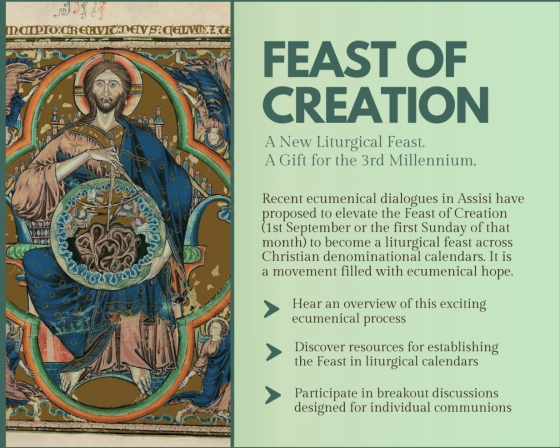
On 19th March, an ecumenical webinar gathered Christians from across the world to reflect on something both simple and profound: the possibility of a new shared liturgical feast.
At the heart of the conversation is the proposed Feast of Creation—to be marked each year on 1 September (or the first Sunday of the month). What might seem, at first glance, like a small addition to the calendar is in fact something much deeper: a sign of unity, a renewal of worship, and a response to one of the most urgent cries of our time.
This proposal has been emerging through an ecumenical journey led by the World Council of Churches together with 13 Christian world communions. Since 2024, dialogues in Assisi have explored how this long-standing day—already rooted in the ancient traditions of the Eastern Church—might become a recognised liturgical feast across all Christian denominations.
The vision is striking. A single day in the Church’s year when Christians everywhere turn together to praise God as Creator, to rediscover the gift of creation in Christ, and to renew their commitment to care for our common home. In a fragmented world, it is also a deeply ecumenical gesture: a shared act of worship that speaks of unity not just in words, but in prayer.
The proposed feast also connects naturally with the wider Season of Creation The Season of Creation is an annual Christian observance that takes place from September 1st to October 4th. It is a time when Christians around the world come together to pray, reflect, and take action on caring for the environment and addressing ecological concerns. The observance begins on the World Day of Prayer for the Care of Creation (September 1st) and concludes on the feast day of St. Francis of Assisi (October 4), the patron saint of ecology in the Catholic tradition. The Season encourages prayer, education, and advocacy for environmental stewardship. Read more about the Season of Creation » More, offering a liturgical anchor that can inspire prayer, reflection, and concrete action in the face of ecological crisis.
Although the March 19th webinar focused on practical steps—resources, liturgical texts, and ways to introduce the feast locally—the wider invitation is spiritual. It asks: what would it mean if care for creation became not an optional concern, but something woven into the Church’s common worship?
If this initiative takes root, it may come to be seen as one of the significant ecumenical developments of our time: a “gift for the third millennium” not only because it adds something new, but because it calls the whole Christian family back to something essential—to recognise creation as gift, and to respond together in gratitude and responsibility.
For further info:
https://oikoumene.org/events/webinar-a-new-liturgical-feast-a-gift-for-the-third-millennium