
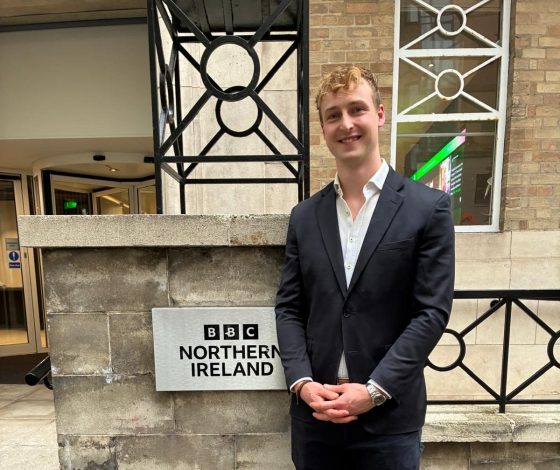
Climate policy and knowledge exchange specialist Kristian Noll was interviewed by Audrey Carville on BBC Radio Ulster’s Sunday Sequence following his visit to Belfast (24th-26th September) to launch the new report An Economy of Enough in a Time of Crisis and Opportunity.
Noll, who works with the Atlantic Fellows for Social and Economic Equity (AFSEE) programme at the London School of Economics, was in Belfast for the launch of the report, which emerged from an Earth Day gathering at Queen’s University Belfast in April. The event brought together people from different faiths, community organisations, academia and civil society to explore how we might build an economy that serves people and planet rather than driving ever-increasing consumption.
Speaking to Carville, Noll described “enough” as having what is needed to meet our own needs, while also having something to share with others. He questioned the idea that progress must always mean more material wealth and consumption, arguing instead for a broader understanding of progress based on peace, unity, wellbeing and stronger relationships.
He highlighted the importance of solidarity and of recognising the different levels of wealth and resources in our communities. He also spoke about the potential of faith communities to provide spaces where people of different generations, disciplines and backgrounds can come together and explore alternative ways of understanding our world.
A recurring theme was the importance of hope. Noll described hope as “an action, not a sentiment”, pointing to the many people and communities already taking practical steps towards a more just and sustainable future. He argued that change can grow from the grassroots, particularly when young people, people of faith and minority communities are given opportunities to collaborate, share ideas and develop practical alternatives.
The interview also explored the relationship between technology, freedom and human wellbeing, the role of the free market in creating wealth and inequality, and the potential for Christian and other faith communities to reconnect climate action with their deeper spiritual traditions.
Asked whether an economy of enough can gain traction in a world dominated by powerful political and economic interests, Noll acknowledged the scale of the challenge but remained hopeful. He pointed to gatherings such as the Belfast conference as spaces where alternative ideas can be tested in practice, shared across communities and gradually brought into wider public debate.
Listen back here: https://www.bbc.co.uk/sounds/play/m0032572?partner=uk.co.bbc&origin=share-mobile