
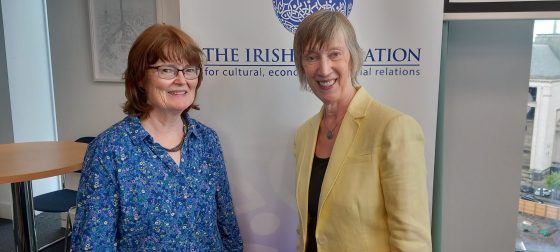
On Thursday 11th June, I attended the Irish Association conference, “Saving Our Lakes: Shared Island Challenges and Opportunities“. The atmosphere in the Lantern Boardroom was charged with a shared sense of urgency, purpose and community. The event was exceptionally well attended, drawing voices from across the political, scientific and local spectrum.
It was also a great opportunity to learn more about the invaluable work of The Irish Association, and it was an absolute pleasure to meet the President, Evelyn Collins, along with other dedicated Council members. It was also great to catch up with Mark Dick from Jubilee Farms.
Professor Duncan Morrow, Director of Community Engagement welcomed us to Ulster University highlighting its strategic aim: “People, Place and Partnership.” Duncan reminded us that connecting scientific research directly with community engagement is perhaps one of the defining challenges of our time, one that demands serious, non-partisan political leadership.
A Historic Gathering: Cross-Border Political Will
A major feature of the day was the powerful cross-border political presence, featuring keynote addresses from Andrew Muir MLA (Minister for Agriculture, Environment and Rural Affairs, NI) and, on video, ROI Minister of State Christopher O’Sullivan. Having Ministers from both Northern Ireland and the Republic of Ireland speak at the same event sent a definitive message: water ignores borders. Managing our inland waters requires a unified, coordinated catchment approach across the entire island.
In her absorbing presentation, Professor Catherine Dalton drew on her seminal book, “Lakes in Ireland: Mirrors of Change”, which is available for download[1]. Did you know that there are 13,855 lakes spread across the island of Ireland? They are defining features of our landscape, yet they are in profound crisis.
Prof Dalton shared a sobering statistic revealing that not a single lake in Northern Ireland is rated above “moderate” ecological health. She pointed out a systemic blind spot in environmental policy: lakes are vastly under-represented in national monitoring strategies compared to rivers. She captured the deep historical and physical significance of these bodies of water, writing: “Lakes are valuable natural assets, providing water for domestic, industrial, and agricultural use and offering amenities for recreation and tourism. Yet they are also sensitive ecosystems, acting as natural archives that record the impacts of human activity and environmental change over millennia.” She explained that our lakes are over 10,000 years old, born from glacial deposits. Their organic sediments act as ancient archives where “each era writes over the last.” Once considered our last true wilderness, these common resources have reached a dangerous ecological threshold.
Deep Ecological Grief and Corporate Responsibility
The programme included three panels: Heritage, Challenges and Futures, as well as a presentation from two PhD students on their research. A full report of the day will be published in due course. A few memorable observations from the discussions give a flavour of the day (while much attention focused on Lough Neagh, many of these insights apply to lakes across Ireland):
- We must move away from the “thingification” of nature. We need a “restoration of relationality” and a return to treating lakes as a “Commons” to be communed with, rather than a resource to be plundered.
- If we solve the Lough, we solve an awful lot more.
- The historical root of the crisis is that Lough Neagh has never had a single, unified statutory management body. Instead, it has faced decades of government inability to manage sewage infrastructure, compounded by a significant 2-degree Celsius increase in water temperature.
- Saving the Lough is not merely an ecological issue, but a deeply democratic one: “Who speaks for the Lough?”
The discussions looked at innovative models worldwide, such as granting legal “Personhood” or Rights of Nature to water systems, similar to recent campaigns in the Wye Valley, to force corporate and legislative accountability.
The Path Forward: From Words to Action
The third panel, “Futures” made a huge effort to conclude proceedings by giving hope. An Italian proverb quoted by Gerry Darby, Manager of the Lough Neagh Partnership, reminded us: “Tra il dire e il fare c’è di mezzo il mare” (Between saying and doing, there lies an ocean). The Earl of Shaftesbury, whose family retains ownership of the Lough Neagh bed and soil, expressed commitment to working with local communities to find a solution to ownership of the lough bed while Dr Neil Read, Reader in Conservations Biology at Queen’s offered very concrete and doable ideas for progressing improvement in water quality.
The consensus of the conference was clear: we cannot afford to monitor extinction in exquisite detail while relying on temporary “techno-fixes” like biochar or roadside gutters. We need:
- Radical Collaboration: Breaking down boundaries between traditional scientific knowledge, local community wisdom, and agricultural sectors.
- Substantial Investment: Acknowledging that billions are needed to upgrade wastewater infrastructure to combat modern pathogens, pharmaceuticals and microplastics.
- Catchment Community Fora: Creating independent agencies and well-funded deliberative assemblies so the public can collectively demand an environmental rethink.
The day concluded on a note of determined hope. We must stop competing for fragmented resources and instead build a unified, multidisciplinary coalition. It is time to marry rigorous academic research with being actively grounded in the water, ensuring that our local actions rise to meet this shared island challenge.
[1] https://oar.marine.ie/entities/publication/1aa958af-5a06-429a-92cd-d23b38d439a9